Lot 147
Nobel Prize Recipient. Sir Henry Hallet Dale ‡
The Petra Collection of Medals to the 22nd Foot (The Cheshire Regiment) & Other Properties | M26001
Auction: 12 February 2026 10:30 GMT
Description
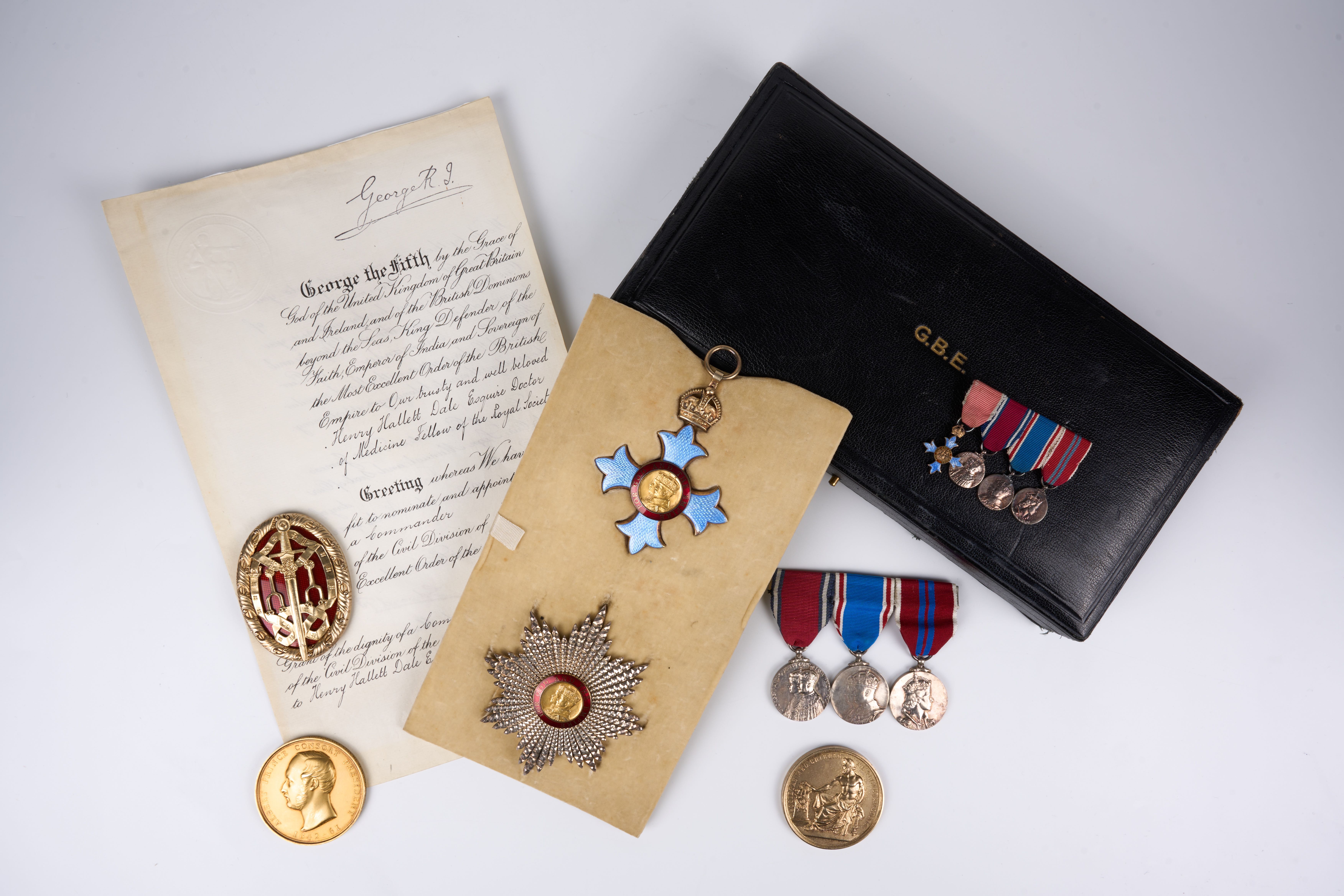
The Impressive G.B.E., Knight Batchelor, group awarded to Nobel Prize Recipient. Sir Henry Hallet Dale who also held the Order of Merit comprising, The Most Excellent Order of the British Empire, G.B.E. (Civil) Knight Grand Cross 2nd type set of insignia, comprising sash badge, silver-gilt and enamels, and breast star, silver with gilt and enamel appliqué centre, complete with evening dress sash, Knight Batchelor’s Badge First Type Breast Badge hallmarked London 1926 unnamed as issued, Jubilee Medal 1935, Coronation Medal 1937, Coronation Medal 1953, these contemporarily mounted for wear unnamed as issued, Society of Arts 10 Karat Gold Prince Albert Medal (Awarded to Sir Henry Dale OM GBE MD FRS For Eminent Service to Science Particularly Physiology 1956), Societas Med. Chirurg Amsteladamensis Silver Gilt Medal (Viro Clarissimo Heny H. Dale De Physiologia et Pharmacologia Opitme Merito) very fine (9)
Knight Batchelor 1932
G.B.E. 1943
Order of Merit 1944
Nobel Prize Recipient. Sir Henry Hallet Dale received world-wide recognition after being awarded the 1936 Nobel Prize in Physiology or Medicine, sharing jointly the award with German-born American physician and pharmacologist Otto Loewi.
The two received the award "for their discoveries relating to chemical transmission of nerve impulses." Being impressed with Loew’s research, Dale nominated him for the Nobel Prize. He received 21 nominations for the Nobel candidacy. In his Nobel acceptance speech, he was very humble making a point of mentioning others who had helped with the discovery. Born one of six children of a London businessman.
He attended Tollington Park College in London; The Leys School at Cambridge; and Trinity College at Cambridge on Coutts-Trotter studentship.
Having a keen interest in physiology, he began his clinical training at St Bartholomew's Hospital from 1900 to 1903, receiving his M.D. in 1909. From 1902 to 1904 he was George Henry Lewes Student and then Sharpey Student with the department of physiology of University College in London.
He first met Loewi in 1902, while Loewi was visiting Ernest Starling’s laboratory at the University College. The two became professional colleagues as well as long-time friends. In 1903 he went to Frankfort, Germany to study. In 1904 he accepted the offer of a research post in physiology at the Wellcome Research Laboratories, where he worked for eighteen months as pharmacologist and the remainder of his ten years there as Director.
In 1936 he became a trustee of the Wellcome Trust, becoming its chairman from 1938 to 1960 and continuing as scientific advisor to 1968. Besides his research on the nervous system, his research on the action of histamine led to studies on anaphylaxis and on conditions of shock.
He supported the international campaign to standardize drugs and vaccines. In 1914, Dale was appointed Director of the Department of Biochemistry and Pharmacology at the National Institute for Medical Research in London, becoming in 1928 Director of this Institute; and he served in this capacity until his retirement in 1942. During World War II, he made a Fullerian Professor of Chemistry at the Royal Institution in 1942 and served on the Scientific Advisory Panel to the Cabinet. He was elected a Fellow of the Royal Academy in 1914. While secretary of the Royal Society from 1925 to 1935, he changed the form of publication of the obituary notices.
The obituaries were published annually in one volume. While president from 1940 to 1945, he not only held a meeting of the Royal Society outside Britain for the first time, in India, but also raised the number of Fellows elected to twenty-five and enabled the revolutionary concept of admitting women as Fellows from 1945.
He received the Royal and Copley Medals of the Royal Society. He was knighted in 1932 and appointed to the Order of Merit in 1944. Other honours besides these and the Nobel Prize, he received the Medal of Freedom from the United States in 1947; the Grand-Croix de l’Ordre de la Couronne from Belgium in 1950, the l’Ordre pour le Mérite from Western Germany in 1955, the Cameron Prize from Scotland, and many other awards.
He received over twenty honorary degrees from universities around the world and was a member of a host of learned societies. Dale did resign from the Academy of Sciences of the U.S.S.R.in protest of the actions of Trofím Denísovich Lysénko, which cause famine in the U.S.S.R. as well as China and the death of millions. Being a prolific writer, he authored 26 professional articles between 1937 and 1942 along with a host of obituaries and biographical tributes to scientists. He voiced his political views in articles in the newspaper, especially the dropping of the atom bomb on Japan.
He was the author of “Adventures in Physiology” in 1953, and “An Autumn Gleaning “in 1954. For his support of the manufacturing of insulin in Britain, the Society for Endocrinology awards the Dale Medal annually to a scientist, who has done outstanding research. He gave an interview with the BBC on his 90th birthday and still expressing his opinion on world politics.
He married his first cousin, and the couple had a son and two daughters. His son-in-law, Alexander Todd, was the 1957 Nobel Prize in Chemistry recipient as well as being president of the Royal Academy from 1975 to 1980.
His brother, Benjamin, was a composer for the Royal Academy of Music. At the age of ninety-three, he died from a heart attack. A memorial service was held at Westminster Abbey for him. The Greater London Council blue plaque was erected in 1981 on the garden wall of his home.
Sold with Case of Issue for the G.B.E., Original Certificate for his earlier C.B.E. and corresponding miniature medals