
Lot 21
Commanding the 11th Battalion the Cheshire Regiment - the nephew of Sir John French – Killed in Action at Thiepval 1916 ‡
The Petra Collection of Medals to the 22nd Foot (The Cheshire Regiment) & Other Properties | M26001
Auction: 12 February 2026 10:30 GMT
Description
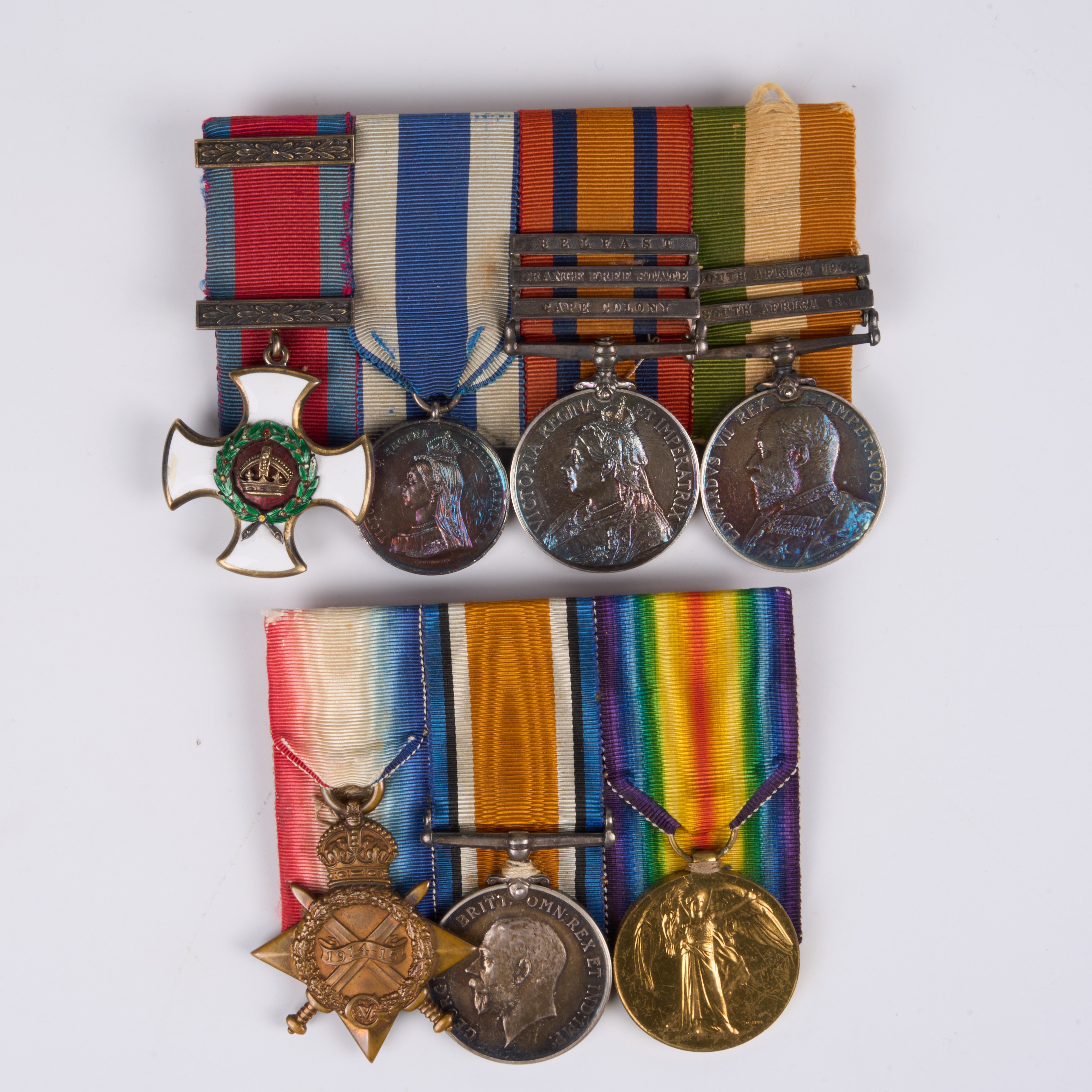
Commanding the 11th Battalion The Cheshire Regiment - the Nephew of Sir John French – Killed in Action at Thiepval 1916 the Boer War DSO, MiD, Great War Group of 7 awarded to Lieutenant Colonel Robert Lowndes Aspinall, Commanding Officer the 11th (Service) Battalion The Cheshire Regiment who was Killed in Action 3rd of July 1916 - “They were met with a withering fire of machine guns under which they walked forward till the Battalion simply melted away. Colonel Aspinall was killed. Every Company Commander was a casualty” comprising, Distinguished Service Order, VR, silver-gilt and enamels, some enamel damage to wreaths unnamed as issued, Jubilee Medal 1897, (Captn. R. L. Aspinall 15th The (King’s) *ussars), (H of Hussars rubbed away), Queen’s South Africa Medal, 2nd type Ghost Dates, three clasps, Cape Colony, Orange Free State, (Capt R.L. Aspinall. A.D.C. Cav. Div. Staff.), this with contemporary re-engraved naming and tailors copy clasps, King’s South Africa, two clasps, South Africa 1901, South Africa 1902, (Capt. R.L. Aspinall. D.S.O.), engraved naming, unit details erased, 1914-15 Star, (Lt. Col. R.L. Aspinall. D.S.O. York. R.), 1914-1920 British War and Victory Medals, (Lt. Col. R. L. Aspinall.). First 4 contemporarily mounted for wear, Great War Trio separately contemporarily mounted for wear, back straps for QSA and KSA clasps removed, toned good fine or better (7)
Distinguished Service Order The London Gazette, 27 Sep 1901
"Robert Lowndes Aspinall, Captain, East Yorkshire Regiment. In recognition of services during operations in South Africa".
(The Insignia was presented by the King on 29 Oct 1901.)
Mentioned in Despatches The London Gazette, 10 September 1901
Lieutenant Colonel Robert Lowndes Aspinall, DSO, 15th (The King's) Hussars and 11th (Service) Battalion the Cheshire Regiment. He was the son of Robert Augustus Aspinall, JP, DL, and Mary Isabella Maria Selby Aspinall (nee Lowndes). He was the nephew-in-law of Sir John French. Educated at Eton College, Berkshire.
Gentleman Cadet at the Royal Military College, Sandhurst. Commissioned into the 15th (The King's) Hussars as a 2nd Lieutenant on 19 Sep 1888. Promoted to Lieutenant on 18 Dec 1889 and to Captain on 10 Jul 1895. He joined his Regiment in Edinburgh, Scotland, serving in Cahir, Ireland (1890-92), Dundalk, Ireland (1893-94), Dublin, Ireland (1895-96), Aldershot, Hampshire (1897-98) and Shorncliffe, Kent (1899). He retired from the Army on 25 Jan 1899 shortly before the Regiment was posted to Meerut, India. He joined the 3rd Battalion the Yorkshire Regiment. He was a very well-known writer on sporting subjects and was a keen sportsman and a prominent figure in regimental race-meetings. He won the Cavalry Brigade Cup at Aldershot in 1897.
He served in South Africa 1900-2 during the Second Anglo Boer War, with the Green Howards (the Yorkshire Regiment), where he served on Sir John French's Staff as ADC, taking part in operations in the Transvaal, east of Pretoria, Jul to Nov 1900, including actions at Reit Vlei and Belfast in the operations in the Transvaal 30 Nov to Dec 1900; operations in Orange River Colony, Dec 1900 to Mar 1901; operations in Cape Colony, Mar to May 1902. He was mentioned in Despatches, The London Gazette, 10 September 1901; received the Queen's Medal with three clasps the King's Medal with two clasps, and was created a Companion of the Distinguished Service Order The London Gazette, 27 Sep 1901:
When WW1 started, he was commanding the 3rd Battalion the Yorkshire Regiment as a Lieutenant Colonel, and later commanded troops of the South Garrison, Redcar. He then raised the 11th Battalion the Yorkshire Regiment. When they became the New Army Reserve, supplying drafts for the Dardanelles and for France, he transferred to the 11th Battalion the Cheshire Regiment and went with them to the Front. The Battalion fought on the Battle of the Somme (1 Jul-18 Nov 1916). On 3 Jul 1916 the Battalion was part of the 32nd Division attack on Thiepval from the direction of Authuille. They struggled thorough heavily shelled communication trenches packed with wounded moving out on stretchers and walking wounded and were hours late in launching the attack. However, an advance was made with little artillery support but with calm deliberation. They were met with a withering fire of machine guns under which they walked forward till the Battalion simply melted away. Colonel Aspinall was Killed.
The following account of his death is taken from his obituary in The Green Howards Gazette: ‘Lieutenant-Colonel Aspinall went up at about 6:30 a.m. on July 3rd to direct operations from the front line, during an attack on the enemy trenches. He went over the parapet with the Reserve Company, intending to establish his Head Quarters in the enemy front line trench. It was while leading the Reserve Company across no man’s land, under heavy rifle and machine-gun fire, that he was struck by a bullet in the right shoulder. On being hit, he fell unconscious and, though at once attended to by stretcher bearers, died almost immediately. Every Company Commander was a casualty. He is buried in Bouzincourt Communal Cemetery Extension, Plot 2 Row B Grave 9.
He is also commemorated on the Eton College WW1 Memorial on the Roll of Honour of Etonians who fought in WW1 on the Folkestone War Memorial, Junction of Road of Remembrance and The Leas, Folkestone, Kent and on the 15th (The King's) Hussars WW1 Memorial in the Royal Memorial Chapel, RMA Sandhurst, Camberley, Surrey Heath Borough, Surrey, England.
He was also Field Marshall Sir John French's nephew and served on his staff in South Africa.
Sold with many photocopied pages of research and Commonwealth War Graves information
Provenance DNW 2002