
Lot 93
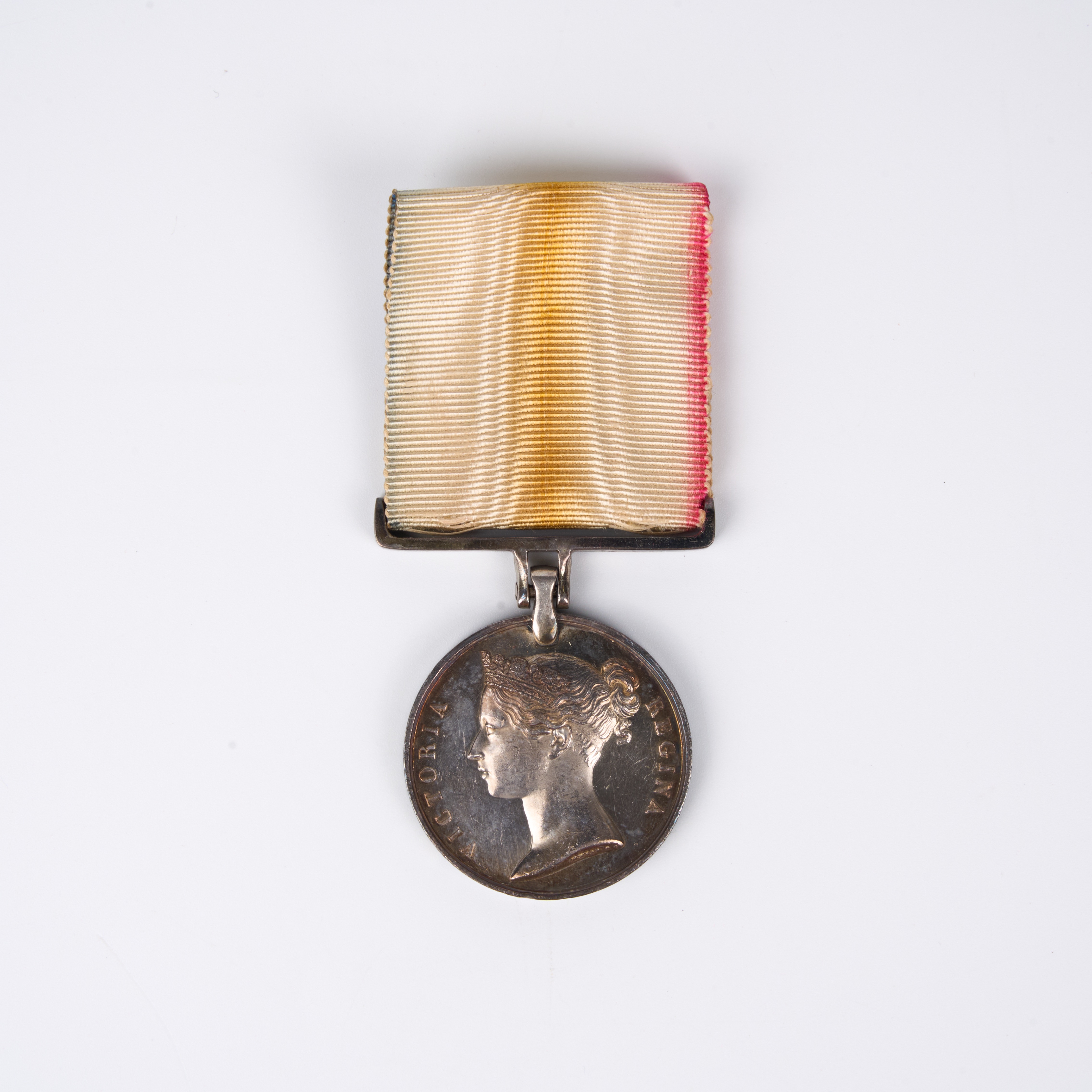
Received the Approbation of General Sir R Bourke and Lord Fitzroy for his Conduct during the Wreck of the Convict Transport Ship Hive ‡
The Petra Collection of Medals to the 22nd Foot (The Cheshire Regiment) & Other Properties | M26001
Auction: 12 February 2026 10:30 GMT
Description
The Scinde Medal awarded to Lieutenant and Adjutant Waldron Barrs Kelly, 22nd Regiment, late 17th Regiment, who Received the Approbation of General Sir R Bourke and Lord Fitzroy for his Conduct during the Wreck of the Convict Transport Ship Hive comprising Scinde Medal 1843 Reverse Hyderabad 1843, (Lieut & Adjt W. B. Kelly. 22nd Regt.), fitted with replacement silver clip and silver straight bar suspension lightly toned very fine (1)
The Hive represents the only known shipwrecked on mainland Australia while carrying convicts. Built in the UK at Deptford, Kent in 1820,
Picking up convicts at Dublin then Cork in Ireland, the Hive departed on 24 August 1835 on her second and fateful voyage. The Hive made the passage with the death of only one prisoner. However, when turning up the east coast of Australia, events took a dramatic turn for the worse. Having not touched land the entire voyage, the transport crawled up the coast towards final disembarkation at Sydney Town. The Hive sailed on during the night of 10 December 1835 but soon found itself driven ashore a total wreck at Wreck Bay.
On board was Captain John Nutting in command of 250 Irish male prisoners, Chief Officer Edward Kenny, Ensign Kelly of the 17th Regiment, Surgeon Superintendent John Donohoe Esq, RN, Lieutenant Lugard of the 31st Regiment, Henry Lugard, Royal Engineers and 29 rank and file soldiers of the 28th Regiment. In addition, there were eight women and eleven children.
About midday on the 10 December, the Hive had sighted land in the vicinity of Montague Island. The chief officer, Edward Kenny thought the vessel to be only 13 to 14 kilometres (8 to 9 mi) off the coast. Informing the captain, his concern was not shared, and Captain Nutting continued a course bringing the vessel closer to shore. Kenny attempted to have the course altered again, but to no avail.
Captain Nutting advised him to mind his own business and that one person is sufficient to navigate the ship! Cautious of danger, Kenny decided not to sleep after the change of the night watch.
The Hive continued under full sail following the captain's instructions. At about 9.30pm, Kenny again tried to convince third mate Thomas Morgan, then on watch, to reduce sail. Not wishing, or daring, to disobey his captain, the vessel plied on into the dark and cloudy night.
Two lookouts were stationed in the forecastle and one on the lee gangway watching for any sight of land. Sometime before 10pm a prisoner reported to Ensign Kelly that he had seen land on the starboard bow. Morgan and the other Officer of the Watch assured Kelly that it was cloud that could be seen as they had been observing it rising for some time. At 10pm Morgan came below decks to break some fearful news to Chief Officer Kenny that there was something white on the port bow that looked like breakers! Kenny rushed on deck and ordered the wheel to be turned hard-a-port. On these vessels this action was designed to turn the vessel to starboard. It was too late for manoeuvring however and the Hive began running through the sand on a gently shelving beach. Luckily for those on board, the vessel did not strike any rocks and there was no violent impact. Ensign Kelly, with unfailing dedication, proceeded by land to gain help, carrying a letter about the wreck from Surgeon Donohoe. With the aid of Aboriginal people from the Wreck Bay area, he found the farm of John Lamb on Friday morning, then proceeded to the farm of Alexander Berry in the Shoalhaven. A message was dispatched to Wollongong and from there to Port Jackson. The wreck was the means of producing much excitement in Sydney and great numbers of the town's people were observed flooding to the Dock Yard and other places where information might be obtained relative to the accident.
The shipwreck victims on Bherwerre Beach were not altogether isolated. In addition to help from Sydney, the Aboriginal community also provided a communication link between Surgeon Donohoe and Alexander Berry.
Alexander Berry, at his own expense, sent his well manned schooner Edward to the scene of the disaster. In a letter to authorities in Sydney, Berry believed that the Hive might again be got afloat if under the direction of an Able commander. Nutting however refused all aid until permission arrived from Sydney. By Sunday, the Government revenue cutter Prince George was dispatched to the wreck with the brig-of-war HMS Zebra under command of Captain McRae and the steam packet Tamar with a detachment of the 17th Regiment.
On 15 December, the Bower anchor was carried out into 6.7 metres (22 ft) of water. Another anchor was carried out on 17 December but a southerly arrived that evening and both anchors "came home". By 20 December Captain Nutting considered any further attempts to keep the ship intact were hopeless.
The Tamar returned to Sydney on 16 December with the Hive's surgeon, Donohoe, Lt. Lugard, part of the guard and 106 convicts. HMS Zebra returned with the specie, the mails, stores, 94 prisoners and ten soldiers from the 28th Regiment, before returning to the wreck to pick up the remainder.
The schooner Edward brought up part of the crew and some of the Hive's stores. By this time, Hive was reported to be lying on the beach with its keel broken and water flowing over the orlop deck. The ship Hive remained virtually intact in the surf zone, although all knew it would break apart in the first big storm. The former Government schooner Blackbird had returned from New Zealand on 4 January with a cargo of timber, potatoes and yams. Having discharged its cargo, the schooner was then engaged to salvage the vessel's stores left onshore, departing Sydney on 11 January 1836.
A serious accident befell the small vessel while engaged on the first day of salvage work on 15 January. Having anchored three point two kilometres (two miles) out into the bay, the vessel's "whaleboats" were used to ferry the bulk of the salvaged goods in twenty-two trips. Returning to the laden schooner at nightfall, a sudden gale greeted the crew about 9pm. Unable to stop the anchor dragging, the crew attempted to hoist sail and get the Blackbird underway. Time was running out, and anchors were dropped as the vessel drew nearer the beach. Securing the schooner for half an hour, the first anchor cable parted, then the other, together with the windlass.
With howling winds, rain and lightning, the little vessel was thrown towards the broken water on the beach. Salvaged cargo was jettisoned to lighten the load. A decision was made to raise all sail and run the vessel onto the beach. Striking the sand several times, at 2.30am on the morning of the 16 January, the Blackbird was carried high onto the beach and out of danger.
Sold with Copy Papers and genealogical information